h58fg4↑↑↑Black Hat SEO backlinks, focusing on Black Hat SEO, Google Raking
h58fg4↑↑↑Black Hat SEO backlinks, focusing on Black Hat SEO, Google Raking
h58fg4↑↑↑Black Hat SEO backlinks, focusing on Black Hat SEO, Google Raking
h58fg4↑↑↑Black Hat SEO backlinks, focusing on Black Hat SEO, Google Raking
AjgKw↑↑↑Black Hat SEO backlinks, focusing on Black Hat SEO, Google Raking
AjgKw↑↑↑Black Hat SEO backlinks, focusing on Black Hat SEO, Google Raking
AjgKw↑↑↑Black Hat SEO backlinks, focusing on Black Hat SEO, Google Raking
h58fg4↑↑↑Black Hat SEO backlinks, focusing on Black Hat SEO, Google Raking
AjgKw↑↑↑Black Hat SEO backlinks, focusing on Black Hat SEO, Google Raking
AjgKw↑↑↑Black Hat SEO backlinks, focusing on Black Hat SEO, Google Raking
AjgKw↑↑↑Black Hat SEO backlinks, focusing on Black Hat SEO, Google Raking
h58fg4↑↑↑Black Hat SEO backlinks, focusing on Black Hat SEO, Google Raking
AjgKw↑↑↑Black Hat SEO backlinks, focusing on Black Hat SEO, Google Raking
AjgKw↑↑↑Black Hat SEO backlinks, focusing on Black Hat SEO, Google Raking
h58fg4↑↑↑Black Hat SEO backlinks, focusing on Black Hat SEO, Google Raking
h58fg4↑↑↑Black Hat SEO backlinks, focusing on Black Hat SEO, Google Raking
h58fg4↑↑↑Black Hat SEO backlinks, focusing on Black Hat SEO, Google Raking
h58fg4↑↑↑Black Hat SEO backlinks, focusing on Black Hat SEO, Google Raking
h58fg4↑↑↑Black Hat SEO backlinks, focusing on Black Hat SEO, Google Raking
AjgKw↑↑↑Black Hat SEO backlinks, focusing on Black Hat SEO, Google Raking
AjgKw↑↑↑Black Hat SEO backlinks, focusing on Black Hat SEO, Google Raking
AjgKw↑↑↑Black Hat SEO backlinks, focusing on Black Hat SEO, Google Raking
AjgKw↑↑↑Black Hat SEO backlinks, focusing on Black Hat SEO, Google Raking
AjgKw↑↑↑Black Hat SEO backlinks, focusing on Black Hat SEO, Google Raking
AjgKw↑↑↑Black Hat SEO backlinks, focusing on Black Hat SEO, Google Raking
AjgKw↑↑↑Black Hat SEO backlinks, focusing on Black Hat SEO, Google Raking
AjgKw↑↑↑Black Hat SEO backlinks, focusing on Black Hat SEO, Google Raking
AjgKw↑↑↑Black Hat SEO backlinks, focusing on Black Hat SEO, Google Raking
AjgKw↑↑↑Black Hat SEO backlinks, focusing on Black Hat SEO, Google Raking
AjgKw↑↑↑Black Hat SEO backlinks, focusing on Black Hat SEO, Google Raking
AjgKw↑↑↑Black Hat SEO backlinks, focusing on Black Hat SEO, Google Raking
h58fg4↑↑↑Black Hat SEO backlinks, focusing on Black Hat SEO, Google Raking
AjgKw↑↑↑Black Hat SEO backlinks, focusing on Black Hat SEO, Google Raking
AjgKw↑↑↑Black Hat SEO backlinks, focusing on Black Hat SEO, Google Raking
AjgKw↑↑↑Black Hat SEO backlinks, focusing on Black Hat SEO, Google Raking
AjgKw↑↑↑Black Hat SEO backlinks, focusing on Black Hat SEO, Google Raking
AjgKw↑↑↑Black Hat SEO backlinks, focusing on Black Hat SEO, Google Raking
AjgKw↑↑↑Black Hat SEO backlinks, focusing on Black Hat SEO, Google Raking
AjgKw↑↑↑Black Hat SEO backlinks, focusing on Black Hat SEO, Google Raking
AjgKw↑↑↑Black Hat SEO backlinks, focusing on Black Hat SEO, Google Raking
AjgKw↑↑↑Black Hat SEO backlinks, focusing on Black Hat SEO, Google Raking
AjgKw↑↑↑Black Hat SEO backlinks, focusing on Black Hat SEO, Google Raking
AjgKw↑↑↑Black Hat SEO backlinks, focusing on Black Hat SEO, Google Raking
AjgKw↑↑↑Black Hat SEO backlinks, focusing on Black Hat SEO, Google Raking
AjgKw↑↑↑Black Hat SEO backlinks, focusing on Black Hat SEO, Google Raking
AjgKw↑↑↑Black Hat SEO backlinks, focusing on Black Hat SEO, Google Raking
AjgKw↑↑↑Black Hat SEO backlinks, focusing on Black Hat SEO, Google Raking
h58fg4↑↑↑Black Hat SEO backlinks, focusing on Black Hat SEO, Google Raking
h58fg4↑↑↑Black Hat SEO backlinks, focusing on Black Hat SEO, Google Raking
h58fg4↑↑↑Black Hat SEO backlinks, focusing on Black Hat SEO, Google Raking
h58fg4↑↑↑Black Hat SEO backlinks, focusing on Black Hat SEO, Google Raking
h58fg4↑↑↑Black Hat SEO backlinks, focusing on Black Hat SEO, Google Raking
h58fg4↑↑↑Black Hat SEO backlinks, focusing on Black Hat SEO, Google Raking
Surprising opening: a majority of wallet losses in DeFi are not from exotic cryptography failures but from users “blind signing” transactions they did not fully understand. That counterintuitive fact reframes where security gains are easiest to capture: not in stronger keys but in better decision-time information. For power users who move large positions across chains, the practical question is which wallet reduces operational risk while preserving composability and speed. Rabby positions transaction simulation and pre-signing risk scans as the core operational defenses — and that is worth unpacking.
This article walks through how transaction simulation works at a mechanism level, why it matters for multi-chain DeFi workflows in the US context, what Rabby delivers and where it still leaves gaps, and a pragmatic checklist for integrating such a wallet into a secure routine. Expect technical clarity rather than marketing claims: I’ll compare trade-offs, highlight boundary conditions, and offer decision-useful heuristics you can apply today.
How transaction simulation works — mechanism, outputs, and limits
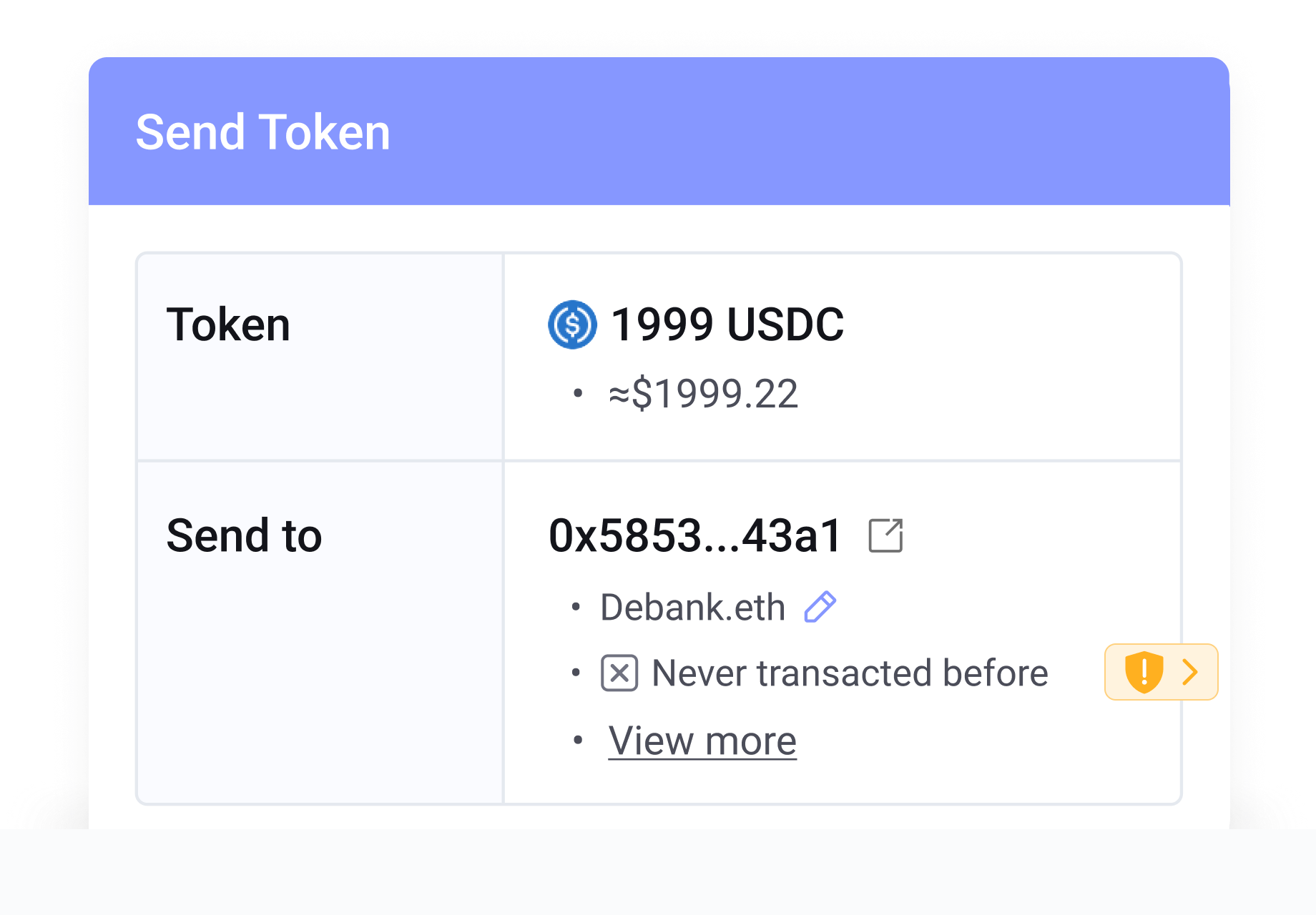
At its simplest, transaction simulation runs the exact transaction locally or against a node without committing it to the blockchain, and reports the resulting state changes: token balances, allowance changes, destination addresses, and estimated gas costs. Mechanically, the wallet reconstructs the call stack and executes it in a read-only context. The benefit: users see an approximation of the end-state they are about to create, not just the raw data encoded in hexadecimal.
Why that is powerful: many attacks rely on user confusion about token approvals, slippage, or multi-step contract calls that bundle transfers and approvals. Simulation surfaces the net balance changes and flags when a contract will pull more tokens than a user expects, or when a transaction includes nested calls that send assets to a third-party contract. In other words, simulation converts opaque bytecode into an actionable delta for human review.
Limitations matter. Simulation depends on accurate node state and the same execution environment as the target chain. On congested or lightly supported chains, estimations for gas or reentrancy-sensitive execution can diverge from on-chain reality. Simulations also do not magically prevent front-running, sandwich attacks, or on-chain oracle manipulation; they only reveal what the transaction will do given current state and current oracle data. Finally, simulation can be bypassed by malicious dApps that construct transactions in ways designed to confuse or hide intent from simple delta-readouts.
What Rabby adds: simulation, scanning, and multi-chain ergonomics
Rabby bundles three mechanisms that matter for power users: pre-transaction simulation with explicit token balance deltas, a security engine that flags risky contracts and approvals, and automatic network switching to keep the user on the correct chain for a visited dApp. For US-based traders and liquidity providers, the practical gains are operational: fewer accidental approvals, faster safe recovery from simple user errors, and reduced context switching across chains.
Rabby is multi-platform (browser extension, mobile, desktop) and integrates hardware wallets like Ledger and Trezor. That combination matters: simulation helps you detect suspicious behavior, hardware signatures keep private keys offline, and integrations with multi-sig and custody tools (Gnosis Safe, Fireblocks) let teams combine automation with institutional controls. If you are running a treasury or managing a DeFi strategy for a fund, that stack is decisive for operational security.
There are clear trade-offs. Rabby does not provide a fiat on-ramp, so US users who prefer buying crypto inside their wallet must still route through exchanges or third-party providers. It also lacks native staking features; if your strategy depends on in-wallet delegation and auto-compounding, you will use external platforms. Those omissions do not affect the core security model, but they do affect workflow convenience and cold onboarding for less technical co-signers.
Where the protection pays off — examples and pitfalls
Consider three common DeFi workflows: (1) approving a DEX router to spend a token, (2) performing a batch swap that chains multiple calls, and (3) bridging assets across chains. In each case, simulation produces specific, actionable outputs: the net token outflows and inflows, the target contract address, and the fee exposure. For approval requests, Rabby’s revocation tool combined with simulation reduces the likelihood of leaving an unlimited approval open — a frequent root cause in many token drains.
Bridging is where Rabby’s cross-chain gas top-up and automatic network switching add operational value: they reduce failed transactions from transacting on the wrong network or lacking bridge gas. But bridges are still systemic risk vectors — rug pulls, broken bridge contracts, and oracle manipulation remain possible. Simulation tells you what a transaction will do now; it cannot guarantee a bridge contract won’t behave differently in the future or be externally attacked after your transaction completes.
Past incidents matter for trust. In 2022 a Rabby Swap contract was exploited for about $190,000. The team froze the contract and compensated users — a recovery pattern seen in mature projects — and subsequently increased audits. That episode is not a condemnation of the architecture; rather it is a reminder that even wallets emphasizing simulation and audits can be exposed through integrated contracts. The defensive posture should therefore be layered: simulation + audits + hardware keys + approval hygiene + institutional safeguards when appropriate.
Practical integration: a minimal operational checklist for power users
Here are pragmatic heuristics you can apply immediately when using a simulation-enabled wallet like Rabby:
1) Treat simulation as a diagnostic, not an oracle. Always validate the contract address and purpose manually, especially for high-value transactions. Simulation helps, but social-engineered or trojanized dApps can still craft plausible-looking deltas.
2) Combine hardware signing with simulation. Use Ledger/Trezor for the final signature step. This reduces the attack surface for stolen browser extension states and provides an offline root of trust.
3) Keep approval scopes tight. Use the built-in revocation tool routinely; if you interact with many DEXes, periodically revoke unused allowances and prefer explicit one-time approvals when possible.
4) Use multi-sig for shared funds. For team treasuries or larger balances, integrate Rabby with Gnosis Safe or a custodial partner. Simulation adds value at the signatory level by clarifying the transaction before cosigners commit.
5) Log and test. For automated strategies, run the same simulated transactions in a staging environment or forked chain and compare outcomes to live simulations. Differences will reveal where simulation assumptions break.
Decision framework: when to adopt Rabby and when to layer other tools
Rabby is best for users who prioritize informed signing and multi-chain convenience: active traders, liquidity managers, and multisig teams who need clear, machine-assisted delta reporting. If your priorities are custodial simplicity (onboarding fiat, seamless staking) or if you require a native fiat ramp and in-wallet staking, Rabby alone won’t satisfy those needs; you will need external services for fiat on-ramps and staking infrastructure.
For institutional contexts, Rabby’s open-source architecture and integrations with custody and multi-sig providers make it a plausible component of a layered security stack. However, institutions should run independent audits of their exact integration paths and simulate their governance approval flows under failure scenarios (lost signer, chain split, fallback liquidity outages) before committing significant assets.
What to watch next — signals that should change your approach
Three developments would materially shift the risk–benefit calculus for simulation-first wallets: (1) improved on-chain privacy techniques that make delta-readouts less revealing, (2) broader adoption of deterministic simulation standards across wallets and dApps, and (3) a reduction in bridge security incidents. If wallet simulation becomes standardized and universally available, the marginal advantage of one wallet over another will shrink; conversely, more bridge failures would raise the value of wallets that clearly expose bridging steps before signing.
In the near term, monitor how wallet teams and dApp developers respond to attempts to obfuscate intent from simulations. That is an open question: attackers will adapt, and simulation outputs may need to become richer (showing internal call graphs, not just deltas) to remain effective.
FAQ
Q: Can transaction simulation prevent all smart contract exploits?
A: No. Simulation reduces human error and detects obvious malicious intent embedded in a transaction, but it cannot prevent exploits that depend on future state changes, re-entrancy bugs triggered by other users, or external oracle manipulation. Treat simulation as one layer in a defense-in-depth strategy.
Q: How does Rabby compare to MetaMask for security?
A: Mechanistically, Rabby differentiates itself by pre-transaction simulation, a risk-scanning engine, automatic network switching, and a native revocation tool. MetaMask has broader market penetration and ecosystem support. The right choice depends on whether you value richer pre-signing diagnostics (Rabby) or a wider plugin ecosystem (MetaMask). Both benefit from hardware wallet pairing and approval hygiene.
Q: Is Rabby suitable for institutional use?
A: Yes, when combined with multi-sig and custody integrations like Gnosis Safe, Fireblocks, or Amber. Rabby’s open-source codebase and hardware support make it a viable component in an institutional stack, but institutions should still conduct integration-specific audits and operational drills.
Q: Where can I download Rabby and try its simulation features?
A: You can find official distribution channels and more information about the wallet, including download options for extension, mobile, and desktop, at this entry point for the project: rabby wallet.